
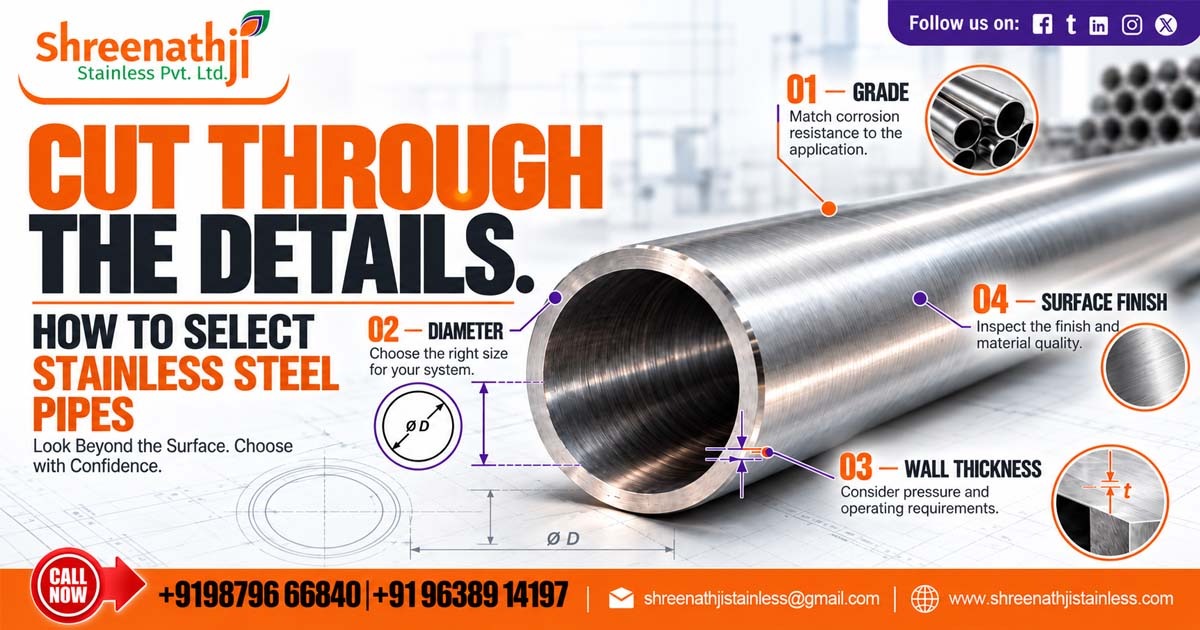
Selecting the right stainless steel pipe is essential for safe fluid transportation, corrosion control, and reliable industrial operations. In Ahmedabad, Gujarat, Shreenathji Stainless Pvt. Ltd. supports buyers with manufacturing and supply coordination to help match pipe selection with process requirements.
Understanding Stainless Steel Pipe Selection for Industrial Systems
Stainless steel pipes carry liquids, gases, steam, and other process materials across industrial facilities. Their performance depends on the steel grade, wall thickness, pipe dimensions, operating pressure, temperature, and the material being transported.
Choosing a pipe based only on its price or outside diameter can create problems later. A pipe that is unsuitable for the process may experience corrosion, leakage, premature wear, or unnecessary maintenance.
Industrial buyers should evaluate the complete operating environment before finalizing their purchase. This is especially important in chemical processing, pharmaceutical production, food manufacturing, water treatment, and engineering projects where material compatibility and consistent performance matter.
Five Factors That Determine the Right Pipe
When deciding how to select stainless steel pipes for industrial applications, consider the following factors before requesting a quotation.
- Steel grade: Grades such as 304 and 316 are common options, but their suitability depends on the chemicals, temperature, and corrosion exposure involved. Grade 316 generally offers better resistance to chloride-related corrosion than 304, although neither is suitable for every environment.
- Pipe dimensions: Confirm the nominal pipe size, outside diameter, and specified wall thickness against the process design.
- Operating pressure and temperature: Check the design conditions, pressure rating, temperature limits, and applicable piping code. Pipe dimensions alone do not establish pressure suitability.
- Manufacturing type: Seamless and welded pipes have different manufacturing characteristics. Select the appropriate type according to design requirements, service conditions, and applicable specifications.
- Surface finish and cleanliness: Processes involving food, pharmaceuticals, or hygienic production may require particular internal surface finishes, cleaning procedures, and documentation.
A clear technical specification helps buyers compare quotations fairly and reduces the risk of ordering material that does not match the intended application.
From Process Requirements to the Final Pipe Order
A structured selection process makes procurement easier and helps prevent avoidable installation issues.
Step 1: Define the operating conditions
Record the fluid or gas being transported, its chemical composition, operating temperature, design pressure, and any cleaning chemicals used in the system.
Step 2: Confirm the material grade
Compare the process environment with the corrosion resistance and mechanical properties of the proposed stainless steel grade. Seek engineering guidance when handling aggressive chemicals or uncertain operating conditions.
Step 3: Finalize dimensions and specifications
Identify the required diameter, wall thickness, pipe length, end preparation, manufacturing type, and relevant material or inspection requirements.
Step 4: Inspect the supply before installation
Check markings, dimensions, surface condition, material certificates where specified, and conformity with the purchase order. Ensure that the delivered pipes are suitable for the planned joining and installation method.
Quality Checks That Prevent Procurement and Installation Problems
Before approving a purchase, buyers should confirm that the supplied pipes match the technical requirements of the project. A low quotation is not necessarily the most economical choice if the material grade, finish, or dimensions are unsuitable.
Use this checklist during supplier evaluation:
- Material verification: Confirm the specified grade and request material test certificates when required.
- Dimensional accuracy: Check the outside diameter, wall thickness, length, and dimensional tolerances.
- Manufacturing consistency: Review weld appearance, surface condition, straightness, and visible defects as applicable to the pipe type.
- Specification compliance: Verify that the product meets the agreed standard and purchase-order requirements.
- Documentation: Confirm inspection reports, traceability records, and other required documents before dispatch.
- Delivery condition: Inspect packaging and handling to prevent scratches, contamination, or damage during transportation.
Installation and Maintenance Considerations
Correct pipe selection is only one part of a reliable piping system. Installation and maintenance practices also influence service life.
- Use compatible fittings, valves, and joining methods.
- Avoid iron-particle contamination from carbon-steel tools or storage areas.
- Follow suitable welding, cleaning, and passivation procedures where applicable.
- Inspect joints, supports, and exposed pipe surfaces periodically.
- Investigate leaks, unusual discoloration, pitting, or deposits before they develop into larger problems.
For pressure-containing systems, the final design and installation should be reviewed by qualified personnel in accordance with the applicable engineering requirements.
Matching Pipe Requirements to the Project
Different industrial projects require different combinations of material, finish, dimensions, and manufacturing method. A decorative fabrication project, for example, may prioritize appearance and dimensional consistency, while a chemical process line requires closer attention to corrosion resistance and operating conditions.
Shreenathji Stainless Pvt. Ltd.’s published product range includes stainless steel pipes in round, square, and rectangular forms, with options that vary by product type. Buyers should confirm the exact available grade, thickness, finish, and specification against their project needs.
When finalizing a requirement, prepare a clear specification covering:
- Intended application and service environment
- Steel grade and required material documentation
- Shape, diameter, thickness, and length
- Surface finish and manufacturing type
- Quantity, delivery schedule, and inspection requirements
This information helps the supplier assess the request and reduces misunderstandings during quotation and ordering.
Services
- Stainless steel pipe product consultation and requirement assessment
- Guidance on available pipe grades, dimensions, shapes, and finishes
- Supply coordination based on project specifications and order quantities
- Assistance with product documentation and pre-dispatch requirement checks
Location: Stainless Steel Pipe Requirements Across Gujarat
Industrial businesses across Gujarat use stainless steel pipes for fabrication, manufacturing, processing, infrastructure, and fluid-handling systems. Shreenathji Stainless Pvt. Ltd. provides manufacturing and supply support from Ahmedabad, Gujarat, India, for customers evaluating pipe requirements in Ahmedabad, Gandhinagar, Vadodara, Surat, Rajkot, Bhavnagar, Jamnagar, Junagadh, Morbi, Bharuch, Ankleshwar, Vapi, Valsad, Anand, Nadiad, Mehsana, Kalol, Sanand, Naroda, Vatva, Changodar, Odhav, Kadi, Himmatnagar, and Bhuj.
How Shreenathji Stainless Pvt. Ltd. Supports Your Selection
Choosing a supplier involves more than checking price and availability. Buyers should look for clear product information, an understanding of dimensional requirements, and confirmation that the proposed material matches the intended application.
Shreenathji Stainless Pvt. Ltd. manufactures and supplies stainless steel pipes and related products, with manufacturing and supply support from Ahmedabad, Gujarat, India. Visit the official website at shreenathjistainless.com to review the available product range and discuss your requirements.
Before placing an order, share the application, grade, dimensions, finish, quantity, and any mandatory specifications. This makes it easier to evaluate product suitability and confirm the details that matter to your project.
Frequently Asked Questions
Q: How do I choose the correct stainless steel pipe grade for my industry?
A: Consider the transported material, corrosion exposure, operating temperature, and cleaning requirements. Compare suitable grades with the process specifications before ordering.
Q: How do pipe diameter and wall thickness affect selection?
A: Diameter influences flow capacity, while wall thickness contributes to pressure resistance and mechanical strength. Both must be selected according to the piping design and operating conditions.
Q: Should I choose welded or seamless stainless steel pipes?
A: The choice depends on the application, design requirements, applicable standards, and operating conditions. Confirm the required manufacturing type before requesting a quotation.
Q: What should I check before buying stainless steel pipes from a supplier?
A: Verify the material grade, dimensions, finish, manufacturing type, documentation, and delivery terms. Also confirm that the supplied product matches the agreed technical specifications.
Conclusion
Understanding how to select stainless steel pipes for industrial applications helps buyers avoid material mismatches, installation difficulties, and unnecessary maintenance. Evaluate the grade, dimensions, operating conditions, and documentation carefully. Businesses across Ahmedabad and Gujarat can contact Shreenathji Stainless Pvt. Ltd. to discuss their pipe requirements and product suitability.
Contact Shreenathji Stainless Pvt. Ltd. through shreenathjistainless.com to discuss stainless steel pipe grades, dimensions, finishes, and supply requirements for your industrial project.
Website: www.shreenathjistainless.com
Email: shreenathjistainless@gmail.com
Phone No: +91 9879666840 | +91 9638914197
For more information, please feel free to contact us.


