
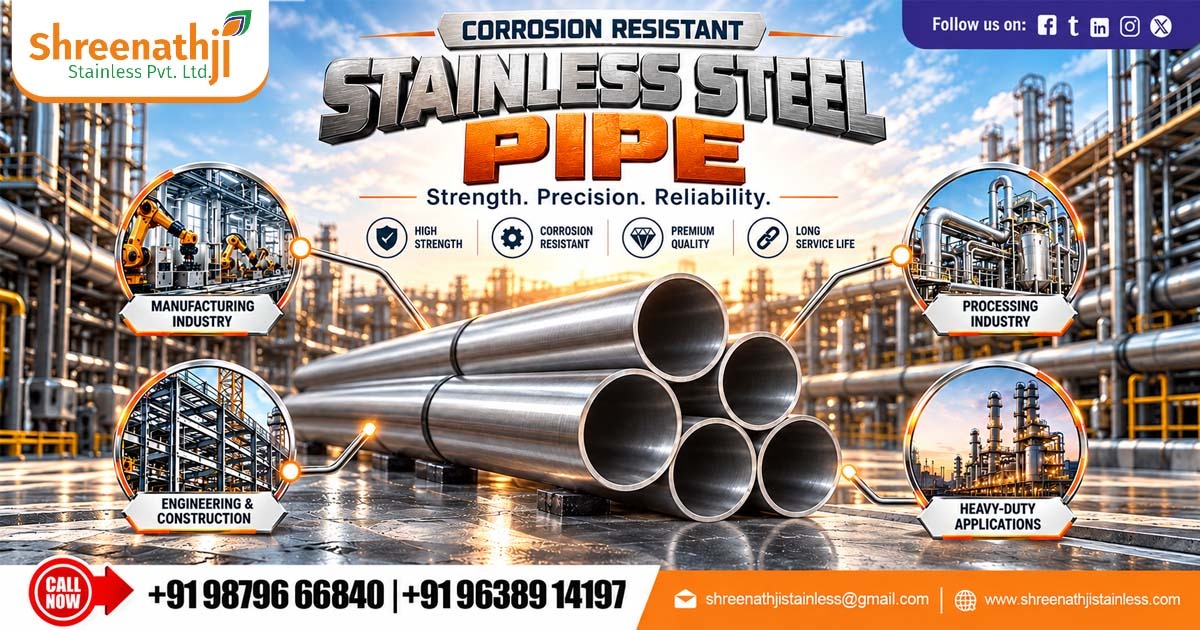
Industrial pipelines exposed to moisture, chemicals, and changing operating conditions need suitable material selection to reduce corrosion risks. Shreenathji Stainless Pvt. Ltd. supports industrial buyers in Chhattisgarh with stainless steel pipe requirements and manufacturing support from Ahmedabad, Gujarat.
Understanding Corrosion Resistance in Stainless Steel Piping
Stainless steel pipes are used in industrial systems where resistance to rust, surface deterioration, and environmental exposure is important.
Their corrosion resistance comes mainly from chromium, which forms a thin protective oxide layer on the steel surface. However, stainless steel is not immune to every corrosive condition. Its performance depends on the grade, chemical exposure, temperature, fabrication quality, and maintenance.
For industrial buyers, the important considerations include:
- Chemical compatibility: The pipe material must suit the chemicals and fluids passing through it.
- Moisture exposure: Humidity, water contact, and condensation can influence corrosion behaviour.
- Temperature conditions: Operating temperature can affect material performance.
- Surface condition: Scratches, deposits, and contamination may create local corrosion risks.
- Fabrication quality: Welding, cutting, and finishing practices influence long-term performance.
A suitable pipe specification should therefore be based on actual operating conditions rather than appearance alone.
Where Corrosion-Resistant Pipes Fit Into Industrial Operations
Common areas of use include:
- Chemical processing and fluid transportation.
- Food and beverage processing installations.
- Pharmaceutical and hygienic processing environments.
- Water treatment and industrial utility systems.
- Oil and gas-related piping requirements.
- Industrial fabrication and structural installations.
- Drainage and irrigation systems.
- Equipment manufacturing and engineering projects.
The required grade and pipe construction may differ between these applications. A pipe suitable for general fabrication may not be appropriate for continuous exposure to aggressive chemicals or chloride-rich fluids.
How to Match the Stainless Steel Grade With Corrosive Conditions
Material grade selection is one of the most important purchasing decisions. Different stainless steel grades offer different levels of corrosion resistance and mechanical properties.
Shreenathji Stainless Pvt. Ltd. lists stainless steel grades including 201, 202, and 304 in its product range. Buyers should understand their differences before confirming an order.
| Stainless steel grade | General characteristics | Selection consideration |
| SS 201 | Commonly used for general fabrication | Evaluate carefully for moisture and corrosive exposure |
| SS 202 | Used in various fabrication requirements | Confirm suitability for the operating environment |
| SS 304 | Offers good general corrosion resistance | Commonly considered for industrial and processing applications |
Important material selection points:
- SS 304 is generally preferred over SS 201 and SS 202 where better general corrosion resistance is required.
- Chloride-rich environments require additional evaluation because pitting and crevice corrosion can occur.
- Chemical concentration and operating temperature should be considered together.
- Material test documentation should match the grade specified in the purchase order.
For highly aggressive environments, an engineering review may be necessary before selecting a standard stainless steel grade.
Pipe Dimensions and Construction: What Should Buyers Specify?
The pipe’s grade alone does not determine whether it is suitable for an installation. Dimensions, wall thickness, construction, and surface finish must also match the project requirements.
The product information published by Shreenathji Stainless Pvt. Ltd. includes the following ranges:
| Parameter | Published product details |
| Round pipe size | 3/8 inch OD to 4 inch OD |
| Outer diameter | 9.57 mm to 101 mm |
| Construction | ERW, welded, fabricated |
| Shape | Round and oval |
| Thickness | 0.24 mm to 2 mm |
| Surface finish | 2B and mirror |
| Grades mentioned | 201, 202 and 304 |
The company also lists square and rectangular pipe options in its product range.
Before ordering, buyers should confirm the required dimensions, thickness, grade, finish, and availability for their particular application. Published ranges should not be treated as confirmation that every combination is available.
What Happens When the Wrong Pipe Material Is Installed?
An unsuitable stainless steel pipe can create maintenance problems even when its external appearance initially looks acceptable.
Some common concerns include:
- Pitting corrosion: Small localised holes may develop due to unsuitable chemical or chloride exposure.
- Crevice corrosion: Corrosion may occur around joints, flanges, and areas where moisture becomes trapped.
- Weld-related corrosion: Poor welding practices or inadequate removal of heat tint can affect corrosion resistance.
- Surface contamination: Contact with carbon steel particles or unsuitable tools can introduce rust contamination.
- Stress-related cracking: Certain combinations of temperature, chloride exposure, and mechanical stress can increase cracking risks.
A Practical Workflow for Planning Stainless Steel Pipe Installation
Stainless steel pipes are generally installed as part of a larger piping arrangement. The following sequence helps project teams organise the work.
1. Review the process requirement: Identify the fluid, chemical composition, operating temperature, pressure, and flow requirements.
2. Finalise the pipe specification: Confirm the stainless steel grade, outer diameter, wall thickness, construction, and finish.
3. Prepare the installation area: Check the piping route, available space, support locations, and accessibility.
4. Complete cutting and fabrication: Ensure pipe dimensions, joint preparation, and welding procedures are suitable for the specified material.
5. Position and connect the pipes: Install the piping with appropriate supports, compatible fittings, and suitable alignment.
6. Inspect and test the installation: Check connections, welds, alignment, and leakage according to the approved project procedure.
7. Commission the system: Conduct the required checks before introducing the operating fluid.
Avoid direct contact with carbon steel fabrication tools and remove welding-related contamination using an approved procedure.
Installation Conditions That Influence Long-Term Pipe Performance
Even correctly selected pipes can experience problems when the installation environment is unsuitable.
Project engineers should pay attention to the following:
- Pipe supports: Use suitable supports that prevent unnecessary movement, vibration, and mechanical loading.
- Joint compatibility: Select fittings, flanges, fasteners, and connecting materials that are compatible with the piping grade.
- Drainage arrangements: Avoid unnecessary liquid accumulation and stagnant pockets.
- Thermal expansion: Consider temperature-related expansion and contraction when planning the piping route.
- External exposure: Protect the pipe from unsuitable chemical contact and chloride-containing materials.
- Welding precautions: Follow appropriate fabrication procedures and ensure weld areas receive suitable treatment.
- Inspection access: Keep joints and critical connections accessible for future inspection.
Chloride-containing insulation, deposits, and contact materials can create external corrosion concerns. Therefore, installation accessories should also be evaluated for compatibility with stainless steel.
Maintenance Checks and Common Piping Problems
Stainless steel piping requires routine inspection even when it is installed in a relatively mild environment.
A preventive maintenance programme should include:
- Checking the external surface for rust spots, pitting, and discolouration.
- Inspecting welded joints and flange connections.
- Looking for leakage around valves and pipe connections.
- Removing accumulated dirt and chemical deposits using compatible cleaning methods.
- Checking pipe supports and clamps for damage or unsuitable contact.
- Inspecting areas exposed to moisture or chemical splashes.
- Reviewing any changes in operating temperature or process-fluid composition.
Common problems and practical responses
| Common issue | Possible reason | Practical action |
| Rust spots | Surface contamination | Identify the contamination source and clean appropriately |
| Small surface pits | Chloride exposure or unsuitable grade | Review fluid chemistry and material suitability |
| Leakage at joints | Damaged seals or connection problems | Inspect and replace unsuitable sealing components |
| Weld discolouration | Heat tint or inadequate post-weld treatment | Arrange appropriate weld-area cleaning |
| Pipe vibration | Insufficient support or system movement | Review support arrangement |
| Deposits inside pipes | Fluid impurities or stagnant conditions | Review cleaning and flushing procedures |
Maintenance frequency should depend on operating conditions, fluid characteristics, and inspection findings. There is no single inspection interval suitable for every industrial pipeline.
What Industrial Buyers Should Verify Before Confirming an Order
A supplier evaluation should cover material identification, dimensional accuracy, documentation, and the ability to meet the project’s actual requirements.
Use this checklist before purchasing:
- Confirm the exact stainless steel grade.
- Verify the required outer diameter and wall thickness.
- Check whether the pipe is ERW, welded, or fabricated.
- Confirm the required round, oval, square, or rectangular shape.
- Specify the required 2B or mirror finish, where applicable.
- Review material test certificates and applicable inspection documents.
- Confirm dimensional tolerances and surface condition.
- Check whether the product is suitable for the intended chemical environment.
- Discuss cutting, fabrication, and customised requirements.
- Confirm quantity, stock availability, and delivery arrangements.
- Understand the supplier’s technical assistance and after-sales support.
Services
Shreenathji Stainless Pvt. Ltd. can be approached for stainless steel pipe-related requirements, including:
- Stainless steel pipe product consultation and grade selection.
- Assistance with pipe dimensions, thickness, and finish requirements.
- Discussion of customised pipe sizes and fabrication-related requirements.
- Product documentation and supply coordination assistance.
Location
Chhattisgarh has important industrial, infrastructure, mining, power, engineering, and manufacturing centres where suitable stainless steel piping is relevant to project development and industrial maintenance.
Major locations: Raipur, Bhilai, Durg, Bilaspur, Korba, Raigarh, Jagdalpur, Ambikapur, Rajnandgaon, Dhamtari, Mahasamund, Kanker, Kawardha, Bemetara, Balod, Janjgir, Champa, Sakti, Mungeli, Baloda Bazar, Tilda, Urla Industrial Area, Siltara Industrial Area, Sirgitti Industrial Area, Borai Industrial Area.
Industrial Pipe Requirements With Shreenathji Stainless Pvt. Ltd.
Shreenathji Stainless Pvt. Ltd. offers stainless steel products, including stainless steel pipes and curtain pipes, for different industrial and fabrication requirements.
For customers searching for a Corrosion Resistant Stainless Steel Pipe Supplier In Chhattisgarh, the company can be approached to discuss product specifications and supply requirements.
Its product range includes SS 201, SS 202, and SS 304 options, along with different pipe dimensions, shapes, construction types, and surface finishes.
The company provides manufacturing support from Ahmedabad, Gujarat, India, and its website, https://shreenathjistainless.com/, provides further product information.
Buyers can discuss their required grade, dimensions, thickness, finish, and project specifications before finalising their purchase. Actual availability and suitability should be confirmed with the company.
Frequently Asked Questions
Q1. Which stainless steel grade is suitable for corrosion-resistant industrial piping?
A: SS 304 is commonly considered for general corrosion-resistant applications. However, chemical concentration, chloride exposure, and temperature must be evaluated before selecting a grade.
Q2. Does pipe thickness affect industrial piping selection?
A: Yes. Wall thickness influences mechanical strength and pressure-handling suitability. It should be selected according to design pressure, temperature, loading, and applicable project requirements.
Q3. Can stainless steel pipes develop corrosion after installation?
A: Yes. Pitting, crevice corrosion, and surface contamination can occur under unsuitable conditions. Correct material selection, fabrication, installation, and maintenance help reduce these risks.
Q4. What documents should buyers request when purchasing stainless steel pipes?
A: Buyers should request relevant material test certificates, grade identification, dimensional details, and inspection documents as required by the purchase specification.
Conclusion
Industrial piping projects in Chhattisgarh require careful consideration of material grade, dimensions, chemical exposure, and installation conditions. Shreenathji Stainless Pvt. Ltd. provides stainless steel pipe options with manufacturing support from Ahmedabad, Gujarat, helping buyers discuss specifications and plan suitable product requirements.
Contact Shreenathji Stainless Pvt. Ltd. to discuss stainless steel pipe grades, dimensions, product availability, and technical requirements for your industrial project in Chhattisgarh.
Website: www.shreenathjistainless.com
Email: shreenathjistainless@gmail.com
Phone No: +91 9879666840 | +91 9638914197
For more information, please feel free to contact us.


